A corporate event photo booth is not the same product as a wedding photo booth — even when the same piece of equipment is involved. The stakes are different, the deliverables are different, and the vendor requirements are different. A photo booth that works beautifully at a Saturday evening wedding can be completely wrong for a Tuesday brand activation if the vendor doesn’t have the right branding capability, data infrastructure, or insurance coverage.
This checklist is built for corporate event planners and marketing managers who need to vet photo booth vendors quickly and confidently — covering everything from equipment standards and brand compliance to post-event analytics and contract terms.
In This Guide
- What Makes a Corporate Vendor Different
- The 25-Point Vendor Checklist
- Questions to Ask Before You Sign
- Red Flags That Should End the Conversation
- What Good Post-Event Deliverables Look Like
What Separates a Corporate-Ready Vendor from a Wedding Vendor
Many photo booth operators serve both markets — but the requirements diverge significantly once you get past the basics. Here’s what changes when the client is a brand rather than a couple.
Wedding / Private Event
Vendor Priority: Guest Experience
Guests have fun, get their photos, post on social media. Success is measured by smiles and props. Templates are decorative. Analytics are optional. Insurance is a checkbox.
Corporate / Brand Activation
Vendor Priority: Brand Compliance + ROI
Every photo carries your brand. Guest data is a marketing asset. Share analytics prove campaign reach. The COI protects the venue and your company. Every element must match brand guidelines.
This distinction matters when evaluating vendors. A vendor who photographs beautifully at weddings but has never built a branded data-capture workflow, generated a post-event analytics report, or furnished a COI for a hotel ballroom is not yet a corporate-ready vendor — regardless of how impressive their equipment is.
Why This Matters for Your Brand
Every photo shared from your event carries your brand’s visual identity. A poorly executed overlay, an off-brand color, or a generic delivery page with no brand presence turns a marketing touchpoint into a missed opportunity — or worse, a brand inconsistency that reaches thousands of guests’ social feeds.
The 25-Point Corporate Photo Booth Vendor Checklist
Use this checklist during vendor evaluation — before you issue an RFP, before you sign a contract, and before you confirm a vendor for an event. Every item marked ✗ should be a conversation, not an assumption.
Equipment & Physical Setup
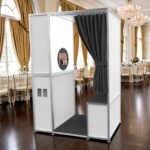
Enclosure is commercial-grade — aluminum, steel, or engineered composite (not ABS plastic or particle board)
Ask the vendor to specify the enclosure material. Budget enclosures look mismatched in premium venues and reflect on your brand.
Enclosure has integrated cable management — no exposed power cables or extension leads visible to guests
Exposed cables are both a liability and a visual red flag in professional event environments.
Vendor has confirmed the setup footprint fits your venue floor plan
Typical setups require a 10×10 ft minimum; confirm ceiling height for 360 booths.
Setup can be completed within your load-in window — vendor has confirmed solo or team setup time
Most professional setups: 20–45 min for iPad booth, 45–90 min for 360 or mirror booth.
Backup equipment plan confirmed — vendor has redundancy for critical components
Ask specifically: “What happens if the tablet fails mid-event?” A professional operator has an answer.
Power requirements confirmed and compatible with venue — standard 110V/15A or specific requirements noted
Some booths, especially 360 setups, may require dedicated circuits. Confirm with venue in advance.
Branding & Customization
Vendor can produce a fully custom branded overlay template — not a generic template with a logo dropped in
Request a sample of a previous branded activation. The difference between a true custom template and a logo slapped onto a stock layout is immediately visible.
Vendor accepts brand guidelines and can match exact hex color codes, fonts, and logo usage rules
Send your brand guide and ask for a mock-up before committing. This is standard for any professional corporate vendor.
Digital delivery landing page is fully branded — vendor’s name and branding do not appear on the guest-facing share page
Guests should see your brand at every touchpoint, including the page where they receive and share their photo.
Vendor can incorporate event hashtag, campaign URL, or QR code into the template and delivery flow
This is how photo booths become active campaign drivers rather than passive entertainment.
Vendor has provided 2–3 examples of previous corporate branded activations for reference
If they can’t show you corporate brand work specifically, they may not have done it at the level your event requires.
Digital Delivery & Data Capture
Vendor supports SMS, email, and QR code delivery — guests can receive content on any device without app download
AirDrop (Apple-to-Apple) is a bonus but not sufficient as the only delivery method at a mixed-device corporate event.
Guest opt-in data capture is active — email addresses and/or phone numbers collected with consent language displayed
Data collected without consent language creates compliance exposure. Confirm the vendor has a visible opt-in prompt.
Data is delivered to you post-event in a usable format (CSV export) — not just visible in a vendor dashboard
If you can’t export the data, you can’t use it for follow-up campaigns. Confirm this explicitly.
Post-event gallery is accessible, shareable, and branded — guests can re-download their photos after the event
A branded post-event gallery extends the campaign lifespan beyond the event day itself.
Vendor will provide a post-event analytics report — total activations, share count, email capture volume, top sharing channels
This is your ROI documentation. A vendor who can’t provide it makes it very difficult to justify the investment to leadership.
Insurance & Compliance
Vendor carries General Liability Insurance — minimum $1M per occurrence / $2M aggregate
This is the baseline requirement for virtually every professional event venue. Some venues require $2M per occurrence — confirm with your venue before requiring only $1M.
Vendor can furnish a Certificate of Insurance (COI) naming your company and/or venue as additional insured within 48 hours
Request this before the event, not day-of. If they’ve never furnished a COI, they have not worked in professional corporate environments before.
Vendor has a signed contract with clear cancellation, overtime, and liability terms
A vendor without a written contract is a vendor without professional infrastructure. This is non-negotiable for corporate events.
Data handling and privacy language is in the contract — guest data usage rights, storage, and deletion timeline defined
Especially important if your event is in California (CCPA) or has EU guests (GDPR). The vendor’s data practices become your company’s liability if not clearly contracted.
Operations & Staffing
A trained attendant will be on-site for the full event duration — not a drop-off / unattended setup
For corporate events with brand compliance requirements, an unattended booth is a risk. Confirm staffed coverage is included or explicitly priced as an add-on.
Attendant is briefed on brand guidelines and can represent your company professionally to guests
Ask if the attendant is the owner/operator or a hired contractor. Either is fine — but they should be briefed before arrival, not day-of.
Vendor has confirmed overtime policy and rate in writing — what happens if the event runs long
Standard corporate rate: $150–$250/hr for overtime. Make sure this is in the contract rather than a conversation at 9pm during your event.
Vendor has experience at events of your scale — confirmed guest count experience comparable to yours
A vendor who has operated at 50-person private parties may not have the throughput experience for a 500-person corporate gala. Ask specifically.
Questions to Ask Every Vendor Before You Sign
These questions aren’t on most planners’ scripts — and the answers reveal far more about a vendor’s corporate readiness than a polished portfolio does.
- Can you send me a mock-up of our branded template before we sign?
Why it matters: Vendors who can produce a mock-up quickly have done it before. Vendors who hedge, ask for a deposit first, or can’t turn one around in 48 hours are telling you something about their process. - What happens if your primary equipment fails during our event?
Why it matters: Professional operators have a specific answer: backup tablet, backup software license, or a secondary unit they can deploy. “We’ve never had a problem” is not a contingency plan. - What format will our guest data be delivered in, and when will we receive it?
Why it matters: The data from your event is a marketing asset. If a vendor can’t answer this question clearly, you likely won’t be able to use the data effectively in post-event campaigns. - Can you provide references from two previous corporate clients — not wedding clients?
Why it matters: Corporate event experience is operationally different from wedding experience. A vendor with five-star wedding reviews may have never navigated the brand compliance, data, and COI requirements of a corporate activation. - Who will be the attendant at our event, and can we speak with them before the day?
Why it matters: The attendant is a brand representative at your event. Meeting them — or at least having a call — before event day reveals whether they’ve been briefed and whether they can represent your brand professionally. - What does your post-event report look like? Can you share a sample?
Why it matters: If you’re reporting to a VP or CMO on activation ROI, “guests loved it” is not a deliverable. A vendor with a real post-event report has built a process that treats your investment as measurable. - What is your COI process, and how quickly can you furnish one naming our venue?
Why it matters: Most professional venues require a COI before the vendor is allowed on property. A vendor who has never furnished one has never worked in a venue that required it — a significant signal about their experience level.
Red Flags That Should End the Conversation
These aren’t minor concerns to work through — they’re signals that a vendor is not ready for corporate event work at the level your brand requires.
🚩No written contract offered
A verbal agreement or an email confirmation is not a contract. If a vendor doesn’t have a standard client contract — with cancellation terms, overtime rates, and liability clauses — they don’t have the business infrastructure for corporate work. Full stop.
🚩Unable to furnish a COI
If a vendor doesn’t carry general liability insurance or can’t produce a certificate of insurance on request, they cannot legally operate at most professional venues. This is not a negotiation point — it’s a disqualifier.
🚩No corporate portfolio — only wedding work
Wedding photo booth work and corporate activation work require genuinely different skills and infrastructure. A vendor with a beautiful wedding portfolio but zero corporate examples has not been held to brand compliance, data delivery, or analytics reporting standards before.
🚩Can’t answer “what happens if the equipment fails?”
No contingency plan means no professional experience managing high-stakes events. At a 300-person corporate product launch, a booth that goes down for 45 minutes is a significant failure. “It won’t fail” is not a contingency plan.
🚩The branded template is a stock layout with a logo on it
You can tell within five seconds whether a “branded” overlay was actually designed for your brand or whether someone dropped a logo onto a generic template. If the vendor’s sample work looks like the second, your guests’ photos will look like the second — and so will every share they post.
🚩Vendor brand appears on guest-facing delivery pages
If guests receive their photo via a link that prominently displays the vendor’s logo and business name instead of yours, that’s a brand compliance failure. Every touchpoint in a corporate activation should carry your brand — not your vendor’s.
🚩Slow or unprofessional pre-event communication
A vendor who takes 3–4 days to respond to an inquiry, sends casual messages that don’t address your questions, or becomes evasive when you ask for references is showing you exactly how they’ll communicate when you have an urgent issue at 6am on event day.
What Good Post-Event Deliverables Look Like
The photo booth experience ends when guests leave the event — but the value it delivers doesn’t have to. A well-run corporate event photo booth vendor provides deliverables that extend the campaign beyond event day and give you the data to report on ROI.
| Deliverable | What to Expect | Why It Matters |
|---|---|---|
| Guest Data Export | CSV with name, email, phone, timestamp, opt-in status | Feeds directly into your CRM or email platform for post-event campaign follow-up |
| Activation Analytics Report | Total activations, shares by channel, peak usage times, share-to-capture ratio | Your ROI documentation — justifies the investment to leadership and informs future event planning |
| Branded Post-Event Gallery | Password-protected or open gallery, branded page, guest re-download access for 30–90 days | Extends social sharing window; guests who didn’t share at the event may share later when they re-access their photo |
| Raw Photo Archive | Full-resolution files from all activations delivered within 48 hours | Gives your marketing team source material for post-event content, internal recaps, and press coverage |
| Video Content (360 booths) | All slow-motion video files in social-optimized format (9:16 and 1:1) | Ready-to-publish content for your brand’s social channels — no editing required |
| Event Summary | 1-page summary of event performance, top-shared content, and recommendations | Slides directly into your post-event debrief deck with no additional formatting required |
💡 Confirm Deliverables Before the Contract Is Signed
Add a deliverables clause to your vendor contract that specifies exactly what you’ll receive, in what format, and by what deadline. “Post-event analytics” means different things to different vendors — “CSV export of all guest opt-in data within 48 hours of event” means one specific thing.
The Vendor Evaluation Summary
A corporate-ready photo booth vendor checks every box on the 25-point checklist, answers your pre-event questions with specificity rather than generalities, produces a branded mock-up that actually matches your guidelines, carries proper insurance, and delivers data you can act on after the event. That combination isn’t rare — but it does require asking the right questions, which is exactly what this checklist is for.
If you’re working with operators in your market, the equipment they use matters as much as their operational experience. Commercial-grade enclosures, professional lighting, and integrated cable management aren’t details — they’re what makes a photo booth look like it belongs at a brand activation rather than a backyard party. When you find an operator who checks every box, ask what equipment they’re running. The answers tell you a lot about how seriously they take their craft.