Most new operators assume they’ll do full-service events — show up, run the booth, break down, go home. Some operators assume they’ll do drop-off because it sounds more passive. The reality is that both models have genuine strengths, genuine limitations, and genuinely different equipment requirements. Choosing the wrong model for your market, schedule, or vehicle situation doesn’t just affect your income — it affects how much you enjoy running the business.
This guide gives you the complete side-by-side breakdown — revenue math, day-in-the-life comparison, equipment requirements, and a five-question decision framework — so you can pick the right model before the first booking, not after the first frustrating event.
In This Guide
- Model Snapshot: Full-Service vs. Drop-Off
- A Day in the Life of Each Model
- Revenue & Margin: How the Numbers Compare
- Equipment Requirements for Each Model
- Which Client Markets Book Which Model
- The Decision Framework — 5 Questions
- Running Both Models at Once
Model Snapshot: Full-Service vs. Drop-Off
Before the math, a clear-eyed summary of what each model actually is and what it commits you to.
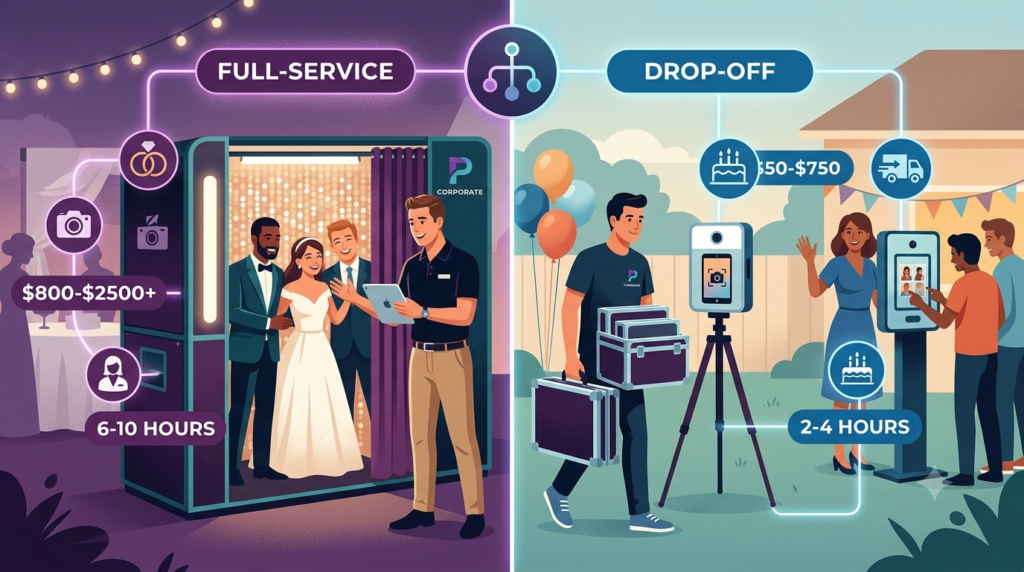
| Full-Service Model | Drop-Off Model |
| Operational Approach You (or a hired attendant) are present for the full duration of the event. | Operational Approach You deliver and set up, then leave the client’s team or guests to operate it. |
| What You Do Deliver, set up, operate, attend guests, break down, and transport. | What You Do Deliver, set up, demonstrate operation to the client, and return later to break down. |
| Time Commitment 6–10 total hours per booking (travel, setup, event, breakdown). | Time Commitment 2–4 total hours per booking (delivery, setup, pickup). |
| Typical Rate $800–$2,500 per event | Typical Rate $350–$750 per booking |
| Revenue Ceiling ~$10,000–$13,000/mo solo (time-limited) | Revenue Ceiling Higher (ability to run 2–3 drop-offs per day in the same time window) |
| Best Market Fit Weddings, corporate events, premium clients | Best Market Fit Birthday parties, backyard events, corporate pop-ups, small venues |
| Client Trust Level High — paying for a high-end, hands-on professional experience | Client Trust Level Moderate — relies on simple, reliable, and user-friendly equipment |
A Day in the Life of Each Model
The best way to understand which model fits your life is to walk through what each one actually looks like on a Saturday — your highest-volume day in either model.
| Time | Activity Details |
| 10:00 AM | Load equipment into vehicle. Check software templates, charge iPad, confirm setup window with venue coordinator. |
| 11:30 AM | Arrive at venue. Navigate load-in (often involves freight elevator, specific entrance, coordinator sign-off). |
| 12:00 PM | Set up enclosure, ring light, backdrop, cable management. Test all delivery flows. Brief any venue staff who interact with the booth area. |
| 5:00 PM | Reception begins. You manage the booth, assist guests, troubleshoot any issues, keep the queue moving, manage guestbook if included. |
| 9:00 PM | Contracted time ends. Pack down, thank the couple, coordinate load-out with venue. Return home. |
| 11:00 PM | Home. Equipment unloaded and ready for next booking. |
| Summary | Total time committed: ~10–11 hours Revenue earned: $1,100–$1,500 Bookings possible today: 1 |
| Time | Activity Details |
| 9:00 AM | Deliver and set up Booth 1 at a backyard birthday party. Brief the host’s contact on how to use it. Confirm pickup time. |
| 10:30 AM | Deliver and set up Booth 2 at a community event venue. Same setup, same brief. Away by 11:15. |
| 11:30 AM | Deliver and set up Booth 3 at a corporate pop-up. Away by 12:30. |
| 12:30 PM | Free window. Handle admin, prospecting calls, or rest. Phone available for any client questions. |
| 5:00 PM | Pick up Booth 1. Quick inspection, load out. |
| 7:00 PM | Pick up Booth 2 and Booth 3. Home by 9pm. |
| Summary | Total time committed: ~8–9 hours total (spread across day) Revenue earned: $1,200–$2,100 (3 × $400–$700) Booths required: 3 |
The Key Insight
Full-service earns more per booking. Drop-off earns more per hour of your time — and scales without hiring, as long as you have the inventory. The “right” model depends on how many booths you own and how you want to spend your Saturdays.
Revenue & Margin: How the Numbers Actually Compare
The revenue comparison is more nuanced than it first appears because the two models have very different cost structures. Here’s a realistic monthly comparison for a single-operator business running one booth vs. two.
| Scenario | Model | Bookings/Mo | Avg Rate | Gross Revenue | Est. Net |
|---|---|---|---|---|---|
| 1 booth, full-service only | Full-Service | 6 | $1,100 | $6,600 | ~$5,800 |
| 1 booth, drop-off only | Drop-Off | 10 | $500 | $5,000 | ~$4,500 |
| 1 booth, mixed model | Both | 4 FS + 4 DO | $850 avg | $6,800 | ~$6,000 |
| 2 booths, drop-off focused | Drop-Off | 18 | $500 | $9,000 | ~$7,500 |
| 2 booths, mixed model | Both | 6 FS + 8 DO | $780 avg | $11,000 | ~$9,200 |
| 3 booths, drop-off scaling | Drop-Off | 24–30 | $500 | $12,000–$15,000 | ~$10,000–$12,500 |
The drop-off model’s power isn’t visible at one booth — it’s visible at two and three. A single full-service operator hits a revenue ceiling around $10,000–$13,000/month because there are only so many hours in a weekend. A drop-off operator with three booths can run 24–30 bookings per month without working significantly more hours, because each booking only takes 45–90 minutes of their time.
Margin Considerations by Model
- Full-service higher per-event margin:Fewer bookings at higher rates means less vehicle wear, fewer consumables, and more time to deliver premium experiences that justify the price. The margin per hour is also often higher.
- Drop-off higher monthly volume margin:Lower per-event revenue is offset by lower per-event labor time. The margin advantage comes from volume — 20 drop-off bookings at $500 is $10,000 gross with roughly the same total hours as 6 full-service bookings at $1,100.
- Drop-off has higher equipment overhead:Running a drop-off scaling model requires owning more booths, which means more upfront capital, more storage costs, and more maintenance. Factor this into your margin math before assuming drop-off is always the more profitable path.
Equipment Requirements for Each Model
The business model you choose directly affects which equipment you need — and what the non-negotiables are for each. This is one of the reasons choosing your model before buying gear matters.
| Full-Service Requirements | Drop-Off Requirements 🔵 |
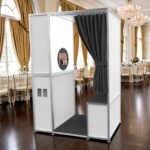
| Commercial-grade enclosure Premium appearance is critical since you’re present and clients are evaluating the total experience. | Highly portable enclosure Tool-free assembly that a non-operator can manage if needed; lightweight for repeated daily transport. |
| Professional lighting rig Guests and staff are actively looking at your setup throughout the event. | Extremely reliable software No vendor on-site to troubleshoot; the UX must be guest-proof from first touch. |
| Printer capability Print add-ons are highest-converting at full-service weddings and corporate events. | Self-explanatory operation Countdown, capture, and delivery must work without explanation for every guest. |
| Full-featured software Branded templates, data capture, and post-event gallery all expected by full-service clients. | Robust transport cases Equipment will be loaded and unloaded 2–3× per day rather than once per weekend. |
| Professional attendant wardrobe & presentation You’re visible and representing the client’s event. | Clear printed setup & usage instructions Left with the client contact for reference during the event. |
| Vehicle capable of carrying full setup Sedan or SUV minimum; van for larger setups. | Multiple units to scale The drop-off model’s revenue advantage only appears at 2+ booths. |
The Equipment Insight
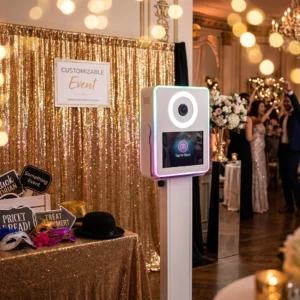
iPad-based enclosures work for both models but are better suited for drop-off due to their portability and simplicity. DSLR and mirror booth setups are almost exclusively full-service — the image quality and operational complexity make them difficult to leave unattended. If you’re planning a drop-off-first strategy, design your equipment selection around portability and reliability, not maximum image quality.
Which Client Markets Book Which Model
Not every client segment is equally open to either model. Understanding who books what — and why — helps you match your model to your local demand before you’ve spent a dollar on marketing.
Weddings
Couples overwhelmingly prefer full-service for weddings — they’ve planned the day for months and don’t want to manage a vendor on top of everything else. An unattended booth at a wedding also creates liability and quality control concerns that most couples aren’t willing to take on. Drop-off can work for very small, casual wedding celebrations (50 guests or fewer in a relaxed setting), but it’s rarely the right fit for traditional wedding receptions.
Best fit: Full-Service
Corporate Events
Corporate clients strongly prefer full-service — brand compliance, data capture, and the professional presentation of an attended setup are all important at brand activations and corporate galas. Smaller corporate events (team parties, office celebrations under 75 people) can work as drop-off, but any event where leadership will be present or where brand compliance matters should be full-service.
Best fit: Full-Service
Birthday Parties & Private Celebrations
The ideal drop-off market. Hosts of birthday parties, anniversary celebrations, graduation parties, and baby showers are usually comfortable operating the booth themselves — especially with a brief in-person walkthrough at delivery. Price sensitivity is higher in this segment, which makes the drop-off’s lower rate structure a natural fit. This is where most drop-off operators build their initial volume.
Best fit: Drop-Off
School Events, Community Events & Fundraisers
These clients often have limited budgets and organized volunteer teams who can manage an unattended setup with minimal guidance. Drop-off is typically the only viable model at the price points these events can afford. Full-service is usually available as an upgrade option, and some operators find that schools and nonprofits become loyal repeat drop-off clients who occasionally upgrade to full-service for premium events.
Best fit: Drop-Off
Retail Pop-Ups & Brand Activations (Small Scale)
Small-scale retail activations — boutique openings, brand sampling events, pop-up markets — often have brand reps on-site who can manage the booth with a brief setup walkthrough. This is a growing drop-off market as brands experiment with experiential marketing on tighter budgets. A drop-off at $500 is often the entry point that leads to a full-service booking at $2,500 once the brand sees results.
Works for Both
The Decision Framework — 5 Questions to Find Your Fit
Work through these five questions in order. Your answers will point clearly toward one model — or toward a hybrid strategy from the start.
How many hours per booking are you willing to commit personally?
6–10 hours per event is fine→Full-service is a natural fit — you’re built for it operationally
I want less than 3 hours per booking→Drop-off is your model — design your business around it from the start
Somewhere in between→Mixed model — full-service on Saturdays, drop-off midweek and Sundays
What’s your primary target market?
Weddings and corporate events→Full-service — these markets expect and require your presence
Birthday parties, small private events, community→Drop-off — lower price sensitivity fits your market’s budget expectations
Both, or not yet sure→Start full-service to validate pricing and market fit, add drop-off at month 3–4
How many booths are you starting with (or planning to own within 12 months)?
One booth, staying at one for now→Full-service maximizes per-event revenue from a single unit
Planning to own 2–3 booths within a year→Drop-off scales more efficiently — design the model around multi-unit from the start
One booth, open to scaling later→Full-service now, add drop-off inventory when cash flow supports the second unit
What vehicle do you have access to?
SUV, minivan, or larger→Either model works — you have the transport capacity for heavier full-service rigs
Sedan or compact crossover→Drop-off with a highly portable iPad enclosure — multiple daily deliveries require a manageable setup
Cargo van or larger→Full-service or multi-booth drop-off — you can carry multiple units and heavy setups
What income goal are you targeting in year one?
$3,000–$8,000/mo part-time→Full-service with 4–6 weekend bookings/month — straightforward path to this range
$5,000–$10,000/mo scaling fast→Mixed model: full-service weekends + drop-off midweek drives volume without burning out
$10,000+/mo full-time income→Multi-booth drop-off scaling strategy — requires capital for 2–3 units but delivers the revenue ceiling you need
Running Both Models at Once — The Natural Scaling Path
The most successful photo booth operators almost universally end up running both models simultaneously — full-service on Saturday evenings for weddings and corporate events, drop-off on Friday evenings, Sunday afternoons, and weekday slots for birthday parties and smaller events. Here’s how to sequence the transition without overextending.
Months 1–3: Establish full-service first
Book your first 8–12 full-service events to validate your pricing, refine your setup process, and build the portfolio photos that will drive future bookings. Don’t add drop-off yet — you need your operation tight before you split your attention across delivery logistics.
Months 3–5: Add drop-off for non-Saturday slots
Once your full-service process is solid, start taking drop-off bookings for slots that don’t compete with your full-service schedule — Friday evenings, Sunday afternoons, weekday corporate pop-ups. These are revenue windows your single booth would otherwise sit idle.
Months 5–9: Use drop-off revenue to fund a second unit
Set aside $800–$1,500/month from drop-off revenue specifically for a second booth purchase fund. When you have enough — or when it makes sense to finance — a second unit dedicated to drop-off lets you double drop-off volume without touching your full-service calendar.
Months 9–12: Two booths, two models, one business
Unit 1 runs full-service events (you or a hired attendant). Unit 2 runs drop-off bookings across the week. Saturday might have both units active simultaneously — a full-service wedding and two drop-offs — with total revenue easily exceeding $3,000 in a single day.
The Model Is Not Permanent
Operators frequently start full-service, discover they hate being at events every weekend, and shift to a drop-off-dominant model. Others start drop-off, find the volume stressful, and move toward fewer full-service bookings at higher rates. Both adjustments are completely normal. The point is to start with intentionality — not to commit forever.