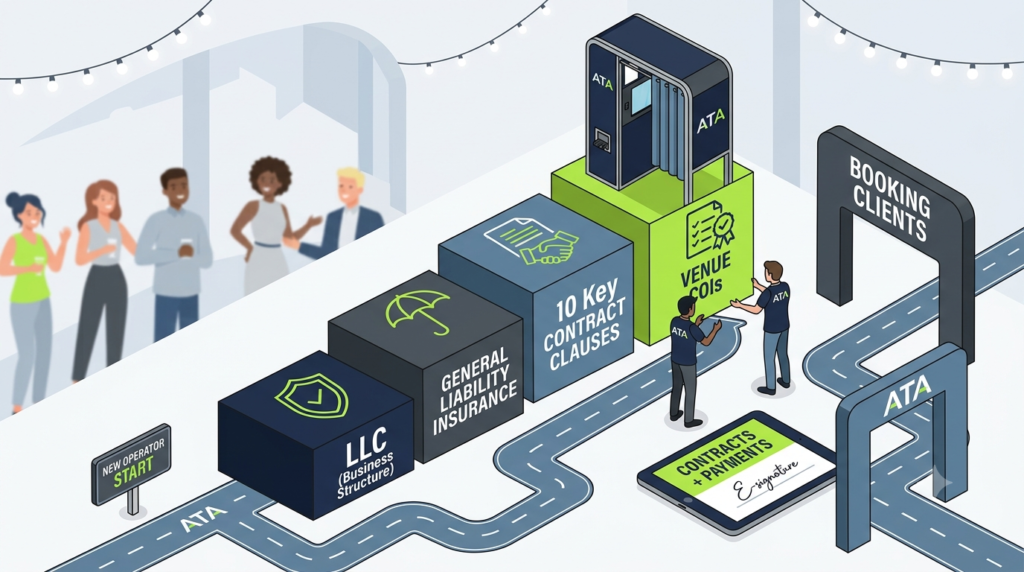
Every new photo booth operator hits the same wall around month one. You’ve got the booth, you’ve figured out pricing, inquiries are coming in — and then a venue asks for a certificate of insurance, a client wants a contract, or someone asks if you have an LLC. If you’re still deciding on equipment and pricing, start with our Ultimate Guide to Professional Photo Booths. This guide is the complete legal and business setup breakdown: what licenses you need, what photo booth business insurance actually protects you, and the photo booth rental contract clauses that safeguard every booking you’ll ever take.
In This Guide
- Business Licensing & Structure
- Photo Booth Business Insurance
- Rental Contract — 10 Key Clauses
- Venue Requirements & COIs
- Common Legal Mistakes to Avoid
The Most Expensive Mistake New Operators Make
Buying a cheap enclosure (or skipping insurance and contracts) to “test the concept” — then discovering 6 months in that it’s the reason you can’t raise rates or win venue referrals. Get the legal and business infrastructure right from the start.
Do You Need a Business License to Run a Photo Booth?
Almost certainly yes — but specifics depend on your state, county, and city. Here’s how to work through it.
Step 1: Choose Your Business Structure
Sole Proprietorship
- Setup: No formal registration needed — you operate as yourself by default
- Liability: No separation between you and the business — personal assets at risk
- Best For: Testing the waters before committing to a full business setup
LLC
- Setup: File Articles of Organization with your state’s Secretary of State ($50–$500)
- Liability: Legal separation between you and the business — personal assets protected
- Best For: Any serious photo booth operation with physical equipment at public events
Why an LLC Matters Specifically for Photo Booth Operators
You’re bringing physical equipment into venues and operating in crowded event spaces. If a guest trips over your power cable, or your equipment damages a venue wall, an LLC is what’s sued — not you personally. Form the LLC before your first paid booking.
Additional Registration Steps
- DBA (Doing Business As): If operating under a brand name other than your own legal name, file a DBA at the county clerk level ($10–$50). Required to open a business bank account under your brand.
- Local Business License: Most cities and counties require a general business license ($50–$200 annually). Check your city and county clerk’s websites.
- EIN (Employer Identification Number): Get this free from the IRS (irs.gov — takes 5 minutes). You’ll need it for your business bank account, taxes, and 1099 contractor arrangements.
Photo Booth Business Insurance — What You Actually Need
Insurance is where new operators either protect everything they’ve built — or find out the hard way why they should have. For a photo booth business, there are two essential coverage types and one critical document you need to understand.
- General Liability Insurance (GL)
GL insurance covers third-party bodily injury and property damage claims. It protects you if a guest trips over your power cable, your lighting stand falls and damages a venue wall, or your equipment causes any property damage at an event. This is the most important policy for any photo booth operator and is required by the vast majority of event venues before you’re allowed to set up. - Equipment Insurance (Inland Marine / Commercial Property Floater)
Your booth represents $3,000–$20,000+ in equipment. Standard homeowner’s or renter’s insurance rarely covers commercial equipment used for business purposes. An inland marine policy covers your gear during transport, at the event, in storage, and in the event of theft, accidental damage, or loss. - Certificate of Insurance (COI) — What Venues Will Ask For
A COI is not a separate policy — it’s a one-page document your insurer generates proving your active coverage. Venues require them before allowing you on-site, and many will specifically request being named as an “additional insured.” Your insurer can generate a COI naming a specific venue within 24–48 hours. Having a process for generating COIs quickly is what separates operators who win venue-referred bookings from those who don’t.
Your Photo Booth Rental Contract — The 10 Clauses That Protect Every Booking
A photo booth rental contract sets crystal-clear expectations, protects you legally if something goes wrong, and signals professionalism that justifies premium pricing. Every contract you send should include all of the following clauses.
| Clause | What It Should Cover |
|---|---|
| Event Details | Exact date, venue address, event start/end time, booth hours, and setup/breakdown windows. |
| Services Provided | Specific booth type, print/digital delivery method, any add-ons. If it’s not listed, it’s not included. |
| Deposit & Payment Terms | Non-refundable deposit amount (25–50% of total), final payment due date, accepted payment methods, late fees. |
| Cancellation Policy | What happens if the client cancels at 30, 14, or 7 days out. Deposit is non-refundable in all cancellation scenarios. |
| Force Majeure | Situations beyond your control (severe weather, medical emergency, equipment failure) where you cannot perform. Define your obligation — typically a full refund or reschedule. |
| Venue & Space Requirements | Power outlet requirements (110V/15A), minimum footprint (typically 10×10 ft), ceiling clearance, parking/load-in access. |
| Liability Limitation | Cap your liability to the amount the client paid. Exclude consequential damages. No liability for venue issues or power failures. |
| Image & Data Usage | Your right (or non-right) to use photos for marketing. How guest data collected via delivery is stored, used, and protected. |
| Overtime Policy | Per-hour rate for time beyond contracted period ($150–$250/hr standard). Overtime billed immediately; you reserve the right to end service if not agreed to in advance. |
| Governing Law & Resolution | Which state’s laws govern the contract. Mandatory mediation clause before any litigation. |
Use a Digital Contract Platform
Tools like HoneyBook, Dubsado, and 17hats let you send, sign, and store contracts digitally with legally binding e-signatures and automatic payment collection. Never hold a date without both a signed contract and a deposit collected.
Venue Requirements: COIs, Preferred Vendor Lists & What to Expect
Venues are your most powerful referral source — and your most demanding compliance requirement. Understanding what venues expect positions you as the professional operator they want to refer.
What Venues Typically Require
- Proof of General Liability Insurance: A current COI naming the venue as additional insured, with $1M per occurrence minimum (some premium venues require $2M). Non-negotiable at virtually every professional event space.
- Business License: Hotels and corporate properties will often ask for a copy before placing you on their vendor list.
- Signed Vendor Agreement: Many venues have their own vendor addendum — a contract you sign agreeing to their property rules, load-in procedures, and liability terms.
- W-9 for Tax Purposes: If a venue or event company pays you directly, they’ll request a W-9 before issuing a check. Have one ready.
Getting on Preferred Vendor Lists
Most established venues maintain a preferred vendor list — a short roster of trusted suppliers they recommend to clients. The path to a preferred vendor list is almost always the same: show up professionally for one or two events booked through a client, deliver an exceptional experience, then follow up with the venue coordinator, provide your COI, and ask to be considered. Professional documentation makes this conversation easy to say yes to.
Common Legal Mistakes New Photo Booth Operators Make
| The Mistake | The Fix |
|---|---|
|
Taking bookings with no contract. A verbal agreement or text message confirmation is not a binding contract. If a client cancels the day before a Saturday booking, disputes scope, or doesn’t pay the final balance, you have no legal recourse without a signed document. |
Set up a digital contract platform. Do this before your first paid booking. Make the signed contract + deposit a prerequisite for confirming any date — no exceptions. |
|
Assuming homeowner’s insurance covers your equipment. Most standard homeowner’s and renter’s policies exclude commercial equipment used for business. If your booth is stolen from your car or damaged at an event, a personal policy almost certainly won’t pay the claim. |
Add business equipment protection. Add an inland marine / commercial equipment floater to your coverage. At $150–$400/year, it protects a $5,000–$20,000 equipment portfolio. |
|
Missing data and privacy language in contracts. If your booth collects guest emails or phone numbers for digital delivery, you’re collecting personal data. Without explicit consent language, you may be violating state privacy laws (particularly CCPA in California) and exposing corporate clients to compliance risk. |
Implement consent workflows. Add a data usage clause to your rental contract and a guest-facing consent prompt in your booth software settings. Most modern platforms include configurable consent screens — enable them. |
|
No overtime or late setup fee policy. Events run long. Without a written overtime rate in your contract, you’ll either work unpaid hours or have an uncomfortable negotiation in the middle of someone’s wedding reception. |
Lock in overtime rates early. Specify your overtime rate ($150–$250/hr) in the contract and communicate it proactively at booking. Clients who know the policy in advance rarely push back at the event. |
Pre-Launch Legal Checklist
[ ] LLC formed and registered with the Secretary of State
[ ] EIN obtained from the IRS (free at irs.gov)
[ ] DBA filed if operating under a brand name
[ ] Business bank account opened
[ ] General liability insurance active ($1M/$2M minimum)
[ ] Equipment / inland marine insurance active
[ ] COI process confirmed with insurer (can generate within 48 hours)
[ ] Contract template finalized with all 10 clauses reviewed
[ ] Digital contract + payment platform configured
[ ] Data consent language in booth software and contract
[ ] W-9 ready for clients and venues who require it