There’s a specific moment that every successful photo booth operator hits — when bookings are coming in consistently, you’re turning away dates, and the question shifts from “can I make money doing this?” to “how big can this actually get?” This is the complete scaling roadmap for photo booth businesses: when to stay solo, when to scale, and how to build a genuine multi-unit operation.
In This Guide
- Solo vs. Multi-Booth at a Glance
- Signs You’re Actually Ready to Scale
- The Solo Operator Ceiling
- What Changes When You Add a Second Booth
- The Scaling Roadmap — Month-by-Month
- How to Finance Your Second Unit
Solo vs. Multi-Booth: The Key Differences
The photo booth business has two genuinely different versions of success. Understanding both is the foundation for knowing which one you’re actually building toward.
Solo Operator
- Revenue Cap: ~$6,000–$10,000/mo (time-limited)
- Overhead: Very low — no payroll, minimal logistics
- Flexibility: High — one unit to track and maintain
- Risk: Low — if something goes wrong, one event affected
- Best For: Operators optimizing margins before scaling
Multi-Booth Business
- Revenue Cap: $15,000–$30,000+/mo (scales with units)
- Overhead: Higher — payroll, insurance, storage, logistics
- Flexibility: Lower initially; higher long-term (runs without you)
- Risk: Higher — team reliability, equipment management
- Best For: Operators ready to build a true business, not a job
Signs You’re Actually Ready to Scale
The most expensive mistake in this business is buying a second booth before the first one is truly optimized. A second unit amplifies whatever system you already have — so check every one of these boxes consistently before committing.
- 6+ Events Per Month, 3+ Consecutive Months
Consistency matters more than peak months. One great December doesn’t signal scale-readiness. - Booking 30+ Days in Advance
A forward-filled calendar signals pricing power and demand — the foundation for unit two. - Turning Away 2+ Requests Per Month
Turned-away bookings are revenue left on the table. A second unit captures that directly. - Setup & Breakdown Under 45 Minutes Solo
Operational efficiency is what makes handing a booth to an attendant possible. - Clean Financials — You Know Your Real Margins
You can’t responsibly add overhead if you don’t know exactly what your current unit costs and earns. - Documented SOPs for All Core Tasks
If the operation lives entirely in your head, it can’t be handed to anyone else.
The Solo Operator Ceiling — Maximize Before You Multiply
Every solo operator running one booth hits an income ceiling — it’s physics. Understanding that ceiling, and maximizing revenue within it before buying a second unit, is the move that separates operators who scale profitably from those who simply get busier.
What the Income Ceiling Actually Looks Like
| Scenario | Events/Mo | Avg Rate | Gross Revenue | Est. Net |
|---|---|---|---|---|
| Underpriced Solo | 6 | $500 | $3,000 | ~$2,200 |
| Optimized Solo (weddings) | 8 | $1,100 | $8,800 | ~$7,200 |
| Optimized Solo + Add-Ons | 8 | $1,350 | $10,800 | ~$8,900 |
| Solo + Drop-Off (hybrid) | 10 | $950 avg | $9,500 | ~$8,100 |
| Solo Maximum (realistic) | 10–12 | $1,100+ | ~$11,000–$13,000 | ~$9,500–$11,000 |
How to Maximize the First Unit First
- Raise your rates: If you’re booking 80%+ of inquiries, you’re underpriced. Raise rates by $100–$200 and test the conversion impact.
- Bundle add-ons into packages: Offer tiered packages where the guestbook, branded overlay, and extended hours are already included. Clients spend more when they don’t choose individually.
- Implement the drop-off model: Drop-off bookings on weekday afternoons are pure incremental revenue — they don’t compete with Saturday evening weddings.
- Pursue corporate bookings actively: A single corporate activation can match two or three wedding bookings in revenue.
What Actually Changes When You Add a Second Booth
Adding a second unit changes the fundamental nature of what you’re running. Understanding what shifts operationally — before you make the purchase — is how you avoid the most common scaling mistakes.
Operations: From Simple to System-Dependent
With one booth, you can hold most of the operation in your head. With two booths running simultaneously on a Saturday, you need written processes for everything. Build your SOPs before the second unit arrives — not under pressure while managing live events.
The Attendant Question — When to Hire and What to Pay
| Role | When to Hire | Typical Pay | Classification |
|---|---|---|---|
| Event Attendant | As soon as you have 2 booths running same-day | $15–$25/hr | 1099 contractor |
| Lead Attendant | When attendant manages setup solo + client interaction | $20–$30/hr + tips | 1099 contractor |
| Operations Manager | 3+ booths, 10+ events/month | $18–$25/hr or % of revenue | W-2 employee |
💡 The Booking Calendar Shift
With one booth, a double-booking is a mistake to avoid. With two booths, a double-booking on the same Saturday is the goal. Configure your booking system for multi-unit tracking from day one of owning unit two.
The Scaling Roadmap — Month-by-Month Framework
Work through each phase in order. Skipping phases is how operators end up with two booths and half the margin of their single-unit days.
Months 1–3 · Phase 1
Foundation & First Bookings
Get your LLC and insurance in place, land your first 5–10 paid bookings, and validate your pricing in your local market. The goal: proof of concept, not revenue maximization.
Months 3–6 · Phase 2
Revenue Optimization & Add-On Stack
Raise rates, build tiered packages with bundled add-ons, actively pursue your first corporate booking, and implement the drop-off model. Target: $6,000–$9,000/month gross on a single unit.
Months 6–9 · Phase 3
Systems & Infrastructure Build
Document every operational process in writing. Interview and train at least one reliable contractor who can run a booth independently. The goal: unit 1 should be able to run without you physically present before unit 2 arrives.
Months 9–12 · Phase 4
Second Unit Launch
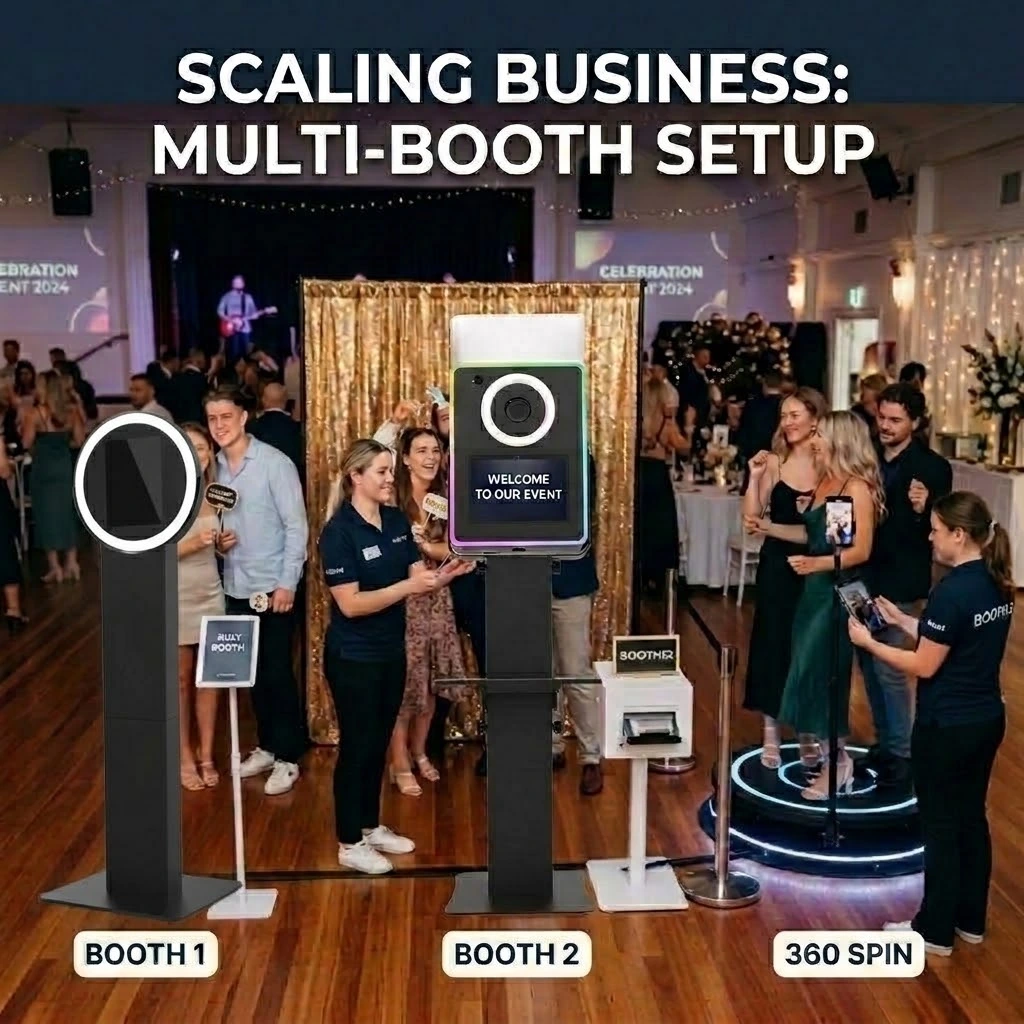
With systems in place and an attendant trained, purchase and deploy unit two. Strategically, your second unit should be differentiated from your first — if unit one is an iPad booth, unit two should be a 360 or mirror booth.
Months 12+ · Phase 5
Portfolio Expansion & Market Dominance
At two units running profitably with a reliable team, you have a repeatable model. Expand into adjacent market segments, build venue referral networks, and explore neighboring markets or white-label services.
How to Finance Your Second Unit
A second booth is a capital investment — from $3,000 for a premium iPad setup to $15,000+ for a 360 machine or mirror booth. The good news: photo booths have an unusually short payback period.
The Payback Math
$8,000 unit ÷ $1,200 avg booking = ~7 events to break even. At 6 bookings/month, that’s just over one month of revenue.
Cash Purchase (Revenue from Unit 1)
Let unit one’s profit fund unit two. Set aside $1,000–$2,000 per month into a dedicated equipment fund. In 4–6 months, you have enough for a second iPad or Windows booth without debt. This approach also forces Phase 3 discipline — you can’t rush to unit two until the savings are there.
Equipment Financing (Vendor or Third-Party)
Equipment financing lets you acquire unit two immediately and pay it down from the revenue it generates. ATA Photo Booths offers financing options that allow operators to structure payments around their booking cadence. At $300–$600/month in payments, a second booth that books even two events per month is net positive from day one.
Business Credit (0% Intro APR Cards)
A business credit card with a 0% introductory APR period (typically 12–18 months) can function as interest-free financing for purchases under $10,000. Key discipline: the booking revenue from the new unit must be used to pay down the balance before the promotional period ends.
Second Unit Pre-Launch Checklist
[ ] All Phase 1–3 milestones confirmed (6+ events/mo, SOPs written, attendant trained)
[ ] Second unit type chosen and differentiated from unit 1
[ ] Financing path selected and approved before purchase
[ ] Insurance policy updated to cover new unit
[ ] Storage solution confirmed for two units of equipment
[ ] Booking system updated for multi-unit calendar management
[ ] Attendant trained on new unit before first live event
[ ] First 3 bookings pre-sold or in pipeline before delivery date